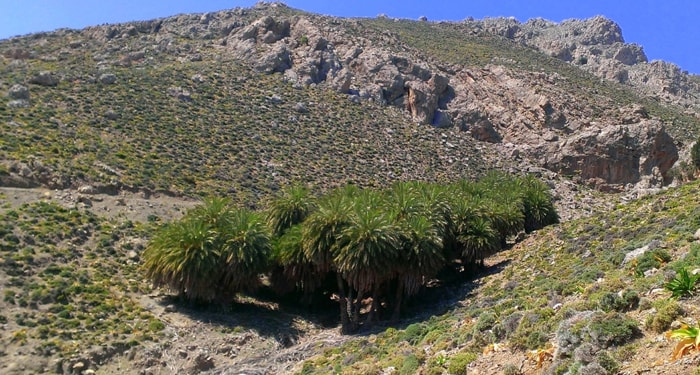
The forest landscape of Crete differs considerably from that of mainland Greece. Dense and extensive forests with clearly defined boundaries are relatively rare, as the vegetation usually forms a continuous mosaic of phrygana, maquis, scattered groups of trees and smaller compact woodlands. For this reason, the boundaries between forest, scrubland and open terrain are not always clear, while even the estimated total extent of the island’s forests depends largely on the definition being used. Phrygana dominate the driest and most degraded soils, from the coast to the mountain zone. Denser maquis develops on deeper soils that retain more moisture. Carob trees, wild olives, kermes oaks, lentisks, strawberry trees, heathers, deciduous oaks, cypresses, Cretan maples, holm oaks and laurels grow among these plant communities, while Calabrian pine is particularly important in southern and eastern Crete. Only in certain locations do the trees become dense enough for their crowns to form a closed canopy and create the appearance of a truly shady forest. Unlike many parts of mainland Greece, Crete does not display clearly separated vegetation zones with evergreen broadleaved trees at lower elevations, deciduous oaks higher up and mountain conifers near the summits. This unusual pattern is not merely the result of human activity. It is also associated with the island’s geological and biogeographical history, as Crete became isolated before some cold-adapted trees, such as firs and black pines, spread through the Mediterranean. At the same time, the Cretan mountains gradually acquired their present elevation, allowing species originally associated with lower ground to adapt over time to mountain conditions. The three most characteristic trees of the mountain forests of Crete are the kermes oak, the cypress and the Cretan maple. The kermes oak grows from low elevations to the upper forest limit and is particularly resistant to grazing. Depending on local conditions, it may remain a low shrub or develop into a large tree. The most extensive and best-known kermes oak forest on the island is found at Rouvas, on Psiloritis, where the oaks grow alongside Cretan maples, cypresses, holm oaks and several other species. The spreading cypress forms impressive woodland on the Cretan mountains, with the largest cypress forest occurring in the White Mountains. On windswept slopes the trees often acquire unusual, low or twisted forms, while on the lower hills of Apokoronas they descend almost to the plains and form dense woodland together with evergreen laurels. Important cypress forests are also preserved in the National Park of the White Mountains, mountainous Kydonia and the area of Kritsa and Kroustas. The Cretan maple likewise grows in the mountain zone but also occurs in lower gorges, demonstrating that the distribution of Cretan trees does not follow rigid and predictable altitudinal boundaries. Forests of Calabrian pine usually extend from sea level to the lower mountain zone. In some places they climb considerably higher, as on the southern slopes of the White Mountains, in the Dikti Range above Selakano and in the mountains of Sitia above Thripti. Calabrian pine readily colonises rocky slopes, sandy soils and abandoned farmland. Consequently, several pine forests represent secondary vegetation that developed following earlier disturbance. A characteristic example of this dynamic process can be seen on Gavdos, where pine trees initially colonised abandoned fields and subsequently spread towards the coast. Important pine and mixed forests are preserved at Kato Symi, Vorizia, Koudoumas, Prina and the southern slopes of the Asterousia Mountains. These forests support numerous endemic and protected species, including the Cretan zelkova and the Cretan cephalanthera, while also providing shelter for many animals and birds. Forests formed by less common tree species have an equally distinctive character. Near Malia lies Azilakodasos, one of the most important holm oak forests in Greece, while the area of Tris Ekklisies preserves a rare native carob forest. The palm groves at Vai and Preveli consist mainly of the native Cretan date palm, while smaller stands of the species occur in several other coastal locations. The present form of the Cretan forests is the result of the long interaction between climate, soil, geological history, competition among plants and human activity. Grazing, fires, logging, cultivation and the abandonment of old farmland may sometimes restrict woodland and, in other cases, encourage the spread of particular species. Despite their frequently open and irregular appearance, the forests of Crete protect the soil from erosion, retain water, support numerous endemic species and form an inseparable part of the island’s natural and cultural landscape.
Read more ...